Codex CLI (preview) · Claude Code · OpenCode · Grok · Antigravity · Cursor
Not just a chat.
An engineering system for agents.
Hyperflow is doctrine, multi-session project memory, task templates, and a reviewed multi-agent chain. Point it at a GitHub issue when you want a PR. Day to day it remembers what your repo taught it, auto-routes intent, decomposes with templates, and keeps workers under specialist review. Your session model. Local by default. Zero extra API keys.
plan → dispatch → audit → deploy · start anywhere, auto-advance forward
The chain
Start anywhere. Auto-advance forward.
Four stages, each one a coordinated multi-agent run. Enter at any stage — from a GitHub issue, a rough idea, or a finished diff — and the chain carries the work forward.
- /plan Chain starter sharpen · design · decompose
- /dispatch Endpoint parallel build + review
- /audit Gate L1–L5 multi-level review
- /deploy Gate pre-push gates, gated push
Normal-flow stages run Worker → Reviewer pairs; inline-fast reviews the allowlisted diff in the foreground.
GitHub-native
Point it at an issue.
Merge a reviewed pull request.
-
/hyperflow:issue #42Paste an issue URL or number. Works with any repo the
ghCLI can reach. -
Triage classifies the thread
Bug → root-cause discipline. Feature → the plan chain. Question → a drafted reply, never a code chain.
-
Spec from the issue's own acceptance criteria
Issue text is treated as data, never as instructions — a prompt-injection boundary, not a convention.
-
Plan → dispatch under review
Parallel workers build; per-batch reviewers check each diff; a final integration reviewer signs off on the whole.
-
Gated PR exit
The branch is pushed and a pull request opens with
Closes #42— only after you approve the gate.
$ /hyperflow:issue https://github.com/you/app/issues/42
▸ triage      feature — routing to plan
▸ spec        synthesized from acceptance criteria
▸ dispatch    3 workers · per-batch reviewer
▸ review      integration reviewer — APPROVED
▸ memory      2 learnings persisted
✓ PR #43 opened — Closes #42
Transcript is illustrative. See real reviewed pull requests in the repo →
/hyperflow:pr #43
Reviews an incoming pull request against its real diff — L1–L5 audit depth auto-selected, findings posted as one batched review (inline, summary, or local-only), merge always gated. Contributor code is analyzed statically, never executed.
Role separation
No output ships unreviewed.
One iron rule: workers never review, reviewers never coordinate. Every normal-flow worker output passes a specialist reviewer before the chain advances; inline-fast has no worker and reviews its allowlisted diff in the foreground.
Plan, route, review
Planners, the triage Brain, and 17 specialist reviewers — frontend, security, database, performance, accessibility, and more — routed per task. Reviewers research current best practices and CVEs before judging.
Execute in parallel
Implementers, searchers, and writers fan out per batch, each stitched with the personas the task needs. On failure the chain retries, escalates, or aborts — it never silently swallows an error.
The system
The whole machine, in numbers.
Memory
Learnings survive the session.
Agents forget. Hyperflow keeps project-scoped memory under
.hyperflow/memory/: learnings, decisions, pitfalls, patterns,
conventions, hot-tier anti-patterns, and structural project-decisions for future specs.
Entries are tagged and tiered (hot / warm / cold). Session start rebuilds a derived index
and injects what the next task needs. Audits write anti-patterns; plans memoize structural answers.
Manage with /hyperflow:cache. Default gitignore keeps memory on your machine;
use handoff packages when another environment must continue the work.
No cloud brain. No cross-repo mix. Optional local usage ledger is metadata-only (no prompts or file contents) for ROI tiles in the viewer.
.hyperflow/memory/
├── index.md            # derived index (auto)
├── learnings.md        # patterns & gotchas
├── decisions.md        # why X over Y
├── pitfalls.md         # failed approaches
├── patterns.md         # reusable shapes
├── conventions.md      # project rules learned
├── anti-patterns.md    # hot: always injected
├── project-decisions.md # memoized for specs
└── archive/            # cold compacted months
Visual artefacts
See the plan, not a wall of markdown.
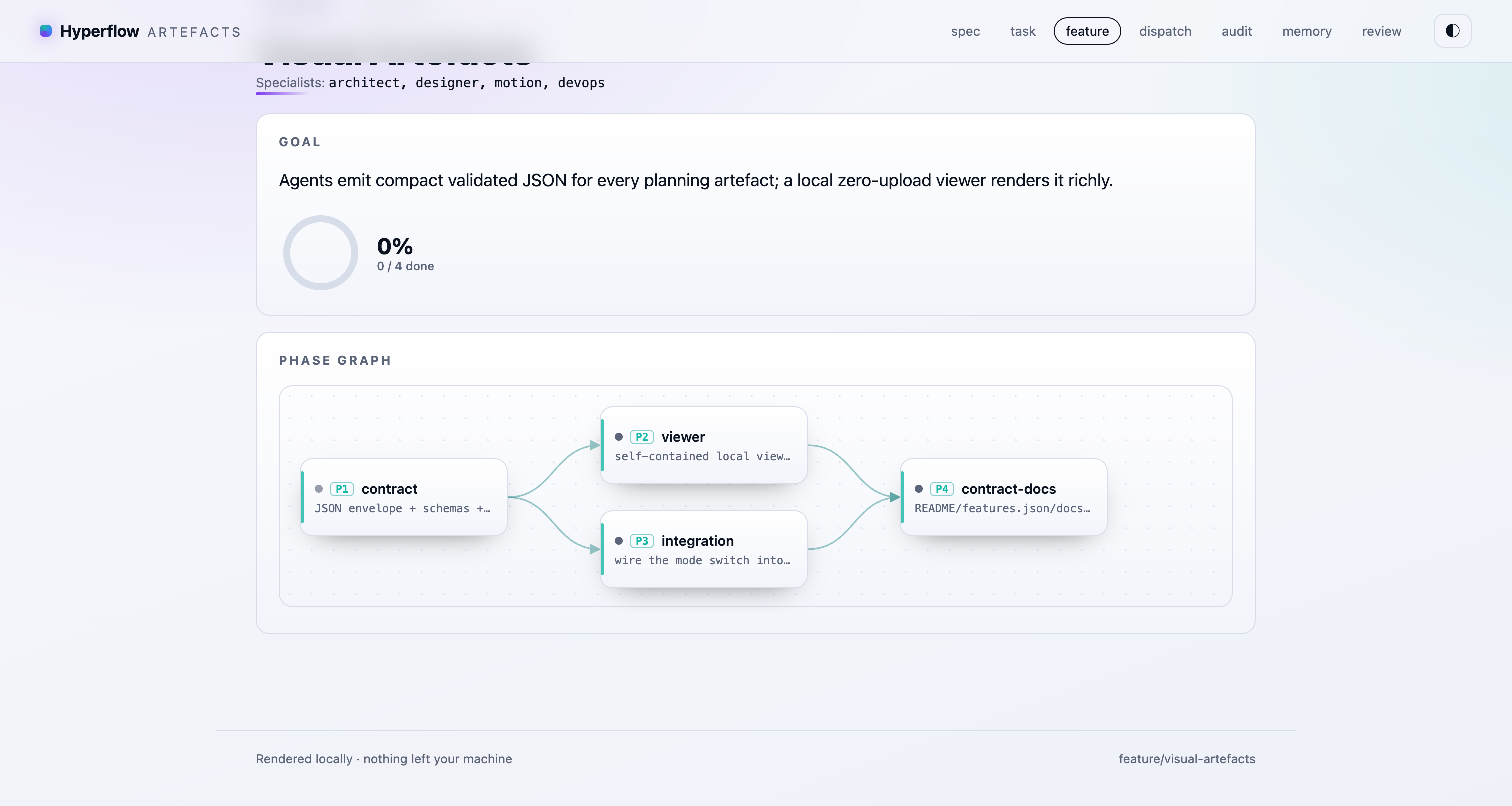
Plans, specs, task graphs, audits, and token/ROI telemetry render as interactive graphs in a
self-contained local viewer — hyperflow view, served on 127.0.0.1. Agents emit
compact JSON instead of hand-writing verbose markdown, so it saves tokens; the renderer ships in the
plugin and binds loopback only, so nothing leaves your machine. Prefer classic markdown?
One config flag turns it off.
Adaptive depth
A 5-line fix never triggers a deep run.
Layer-0.5 triage reads the request and picks one of six flow profiles — worker count, review depth, and token budget all size to the task.
| Profile | Use when | Shape |
|---|---|---|
| fast | Clear, reversible 1–2 ordinary-file fixes (inline-fast preflight) | 0 dispatched workers; foreground edit + allowlisted diff review |
| standard | Typical features and refactors | 1–2 workers; per-batch review |
| deep | Cross-cutting or risky surfaces | 3+ workers; integration review |
| research | Unknowns needing external evidence | Web-research-first specialists |
| creative | Design systems, visual work | Designer + taste review |
| scientific | Numerical, data, ML correctness | Reproducibility discipline + TDD bias |
Runs everywhere
Your tools. Your model. Guarded by default.
Six AI coding tools
Claude Code · OpenCode ·
Grok · Antigravity · Cursor ·
Codex CLI (preview; App pending)
Every agent runs on your current session model — there is no model routing to configure and no extra API bill. A portable doctrine skill carries the full ruleset into single-agent surfaces. Codex CLI, app-server, and desktop App are certified separately; App remains pending — see Codex support matrix.
A blocklist ships in the box
25 blocked file patterns (keys, secrets, cloud creds) ·
15 blocked commands (rm -rf, force-push to main,
sudo) · 11 secret patterns scanned in diffs.
Push and merge are always gated behind your explicit confirmation —
never --no-verify, never a force-push to main.
Install
Direct from GitHub — verified and live.
The GitHub marketplace path ships every fix the day it lands. Pick your tool:
claude plugin marketplace add Mohammed-Abdelhady/hyperflow
# Step 2 — install the plugin
claude plugin install hyperflow@hyperflow-marketplace
codex plugin marketplace add Mohammed-Abdelhady/hyperflow
# Step 2 — install the plugin
codex plugin add hyperflow@hyperflow-marketplace
curl -fsSL https://raw.githubusercontent.com/Mohammed-Abdelhady/hyperflow/main/install.sh | bash
/hyperflow:plan "add user auth with login page and middleware"
# Or start from a GitHub issue
/hyperflow:issue https://github.com/you/app/issues/42
# Inspect multi-session memory
/hyperflow:cache show
# Optional: local graphs + dashboard
hyperflow view
Hyperflow runs locally in Claude Code, OpenCode, Grok, Antigravity, Cursor, and
Codex CLI (marketplace install is preview / not certificate-certified
yet; desktop App is pending). On Codex, /hyperflow:* forms are
textual Hyperflow aliases, not native Codex slash commands
(hyperflow <verb> is the portable form). Claude Code Desktop and
claude.ai web still need the portable CLAUDE.md fallback because they do not load
terminal plugins — see the full installation guide
and the Codex support matrix.